Battling Beavers

Page wire helps keep the beavers out of Gowan’s Grove, but some always manage to sneak in and cut down trees, just as they’d demolished my Uncle Gordon’s grove. It took fifty years to grow these precious trees on the bald prairie. We grew up protecting them. I remember cold nights beside the creek with my father, cradling rifles in our arms, waiting.

220px-Beaver_signs

One morning last summer I got up at eight, crawled out of the tent, and walked straight down to see whether Ray had caught another beaver. He had. Got it headfirst, by the neck, as it was attempting to leave with a small twig of poplar in its mouth. When Ray arrived we puzzled over this, looking for a place it might have penetrated the fence without crawling through the trap.

“Nothing about it makes any sense,” Ray said. There was no way it could have passed through the Conibear trap and into the Grove without tripping the wire. We couldn’t find another place it might have entered. We reasoned that it may have already been inside when he arrived last night to set the trap, and managed to hide when it heard him coming. Doubtful as it seemed (especially since we couldn’t find any sign of it chewing any trees except the branches he’d left for bait at the opening) it was the only possible explanation.

Once Ray had removed it from the trap we each grabbed a leg and carried it to the truck. Its musk was strong and it was large, but smaller than others he’d caught before, he told me. One recently was big enough he couldn’t carry it by himself and was forced to drag it in short bursts. We dumped it in the back of his red pick-up and he drove up to the house, where he threw it in the deep-freeze in the garage. A friend of his would use it as bait for hunting black bear.

I realize that this will all seem cruel to many, but I hope that they will also recognize a connection to nature that is now often lacking, and a respect that can only really exist with direct contact and the conflict that proximity naturally brings.
Gowan’s Grove

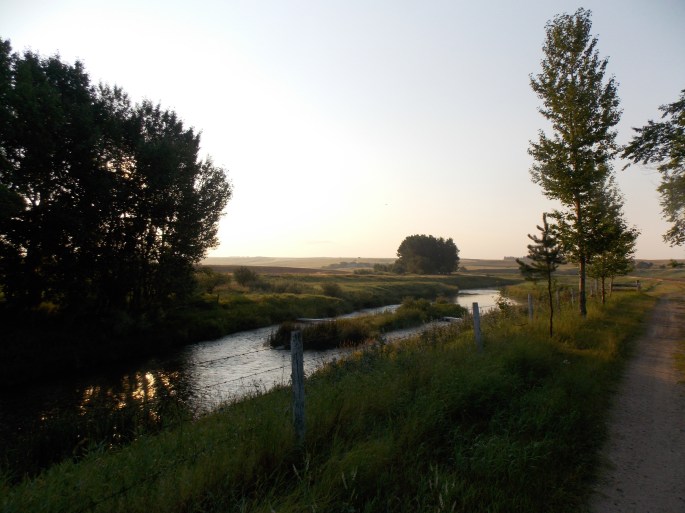
Back in the late 20s or early 30s my grandfather’s brother Gordon, who farmed just south of my grandfather, planted a grove of poplars along the Swift Current Creek. The spot became a gathering place for the community: picnics and parties and that sort of goings-on. My father remembered it with intense fondness and regret. It was only a distant memory by the time I was born because sometime in the early 40s the beaver invaded and razed every single tree.

gordonsgrove
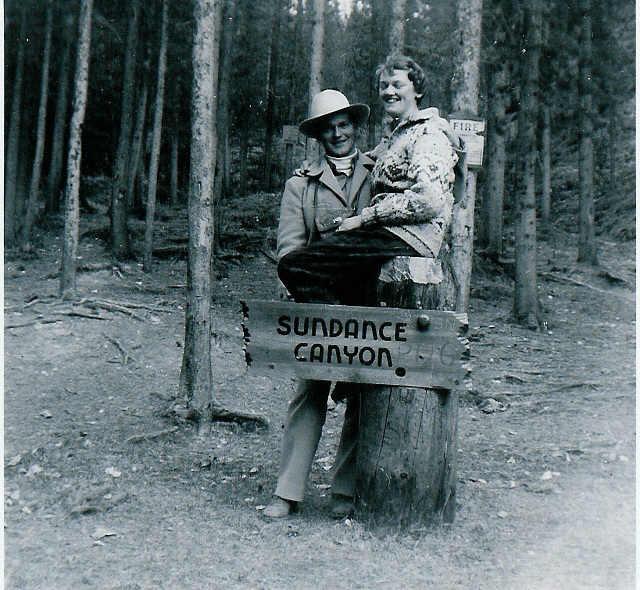
Uncle Gordon with unidentified companion at the original Gowan’s Grove

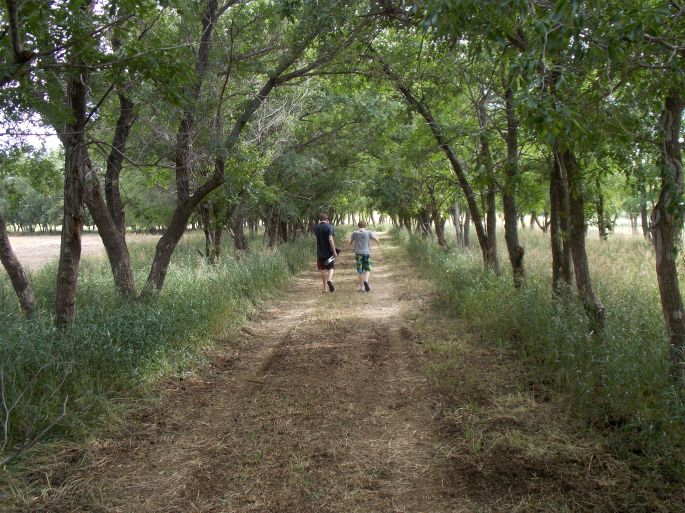
Beginning in the mid-60s, under my father’s direction, the whole family took part in the planting of Manchurian elm and poplar at the edge of the field and along the Swift Current Creek across the grid road to the north of our house. Dad left a wide enough swath between the rows of seedlings that he could cultivate them with the tractor, except down at the northern-most tip. There we planted the trees in circles, and had to rototill them to kill the weeds. Lodgepole pines were transplanted from The Cypress Hills in the 80s or early 90s.

DSCN5342

Acres and acres of trees. I’m sure some people thought Dad was crazy, planting trees where he could have planted grain. Nurturing and protecting them has become one of my brother Ray’s major projects.

The prairies are a dry country and trees like rain. Over the years many of them died (or were dying back in the case of the particularly hardy Manchurian elm) and so during the two years before Dad died, Ray started pumping water from the creek directly into the ground. There’s an underground slough fourteen feet down that the trees will suck dry on a bad year. His experiment revived many of the elm and poplar and the stunted pines along the creek bank.

DSCN1673

The Grove is used by the Boy Scouts and Girl Guides and various other community groups as a campground and retreat. Music and art camps are held there every summer. And other goings-on: Fred Eaglesmith has played a concert there.

Dad’s ashes are buried at the foot of an oak planted a few years before he died.

Drowning Fantasies

I should also mention the thirty inch eave that jutted out between the first and second storey. This eave, like the one a storey above, was slightly inclined to shed water and protect the walls and windows from rainfall and melting snow. They were flat enough that they made an ideal ledge for a child to walk along. There was easy access, as Dad had made a staircase that led right up onto the roof, to a sort of deck he’d built along the north side of the house. Unfortunately, he made the incline on the deck a bit too steep to be entirely functional, and it was never used like a regular deck for gathering and watching the sunset. One of our dogs liked to sleep there outside Mom and Dad’s bedroom window and bark like a sentry at any vehicle that drove into the yard: thus visitors were met by the sight of a dog on the roof.

DSCN5147

It was a thrill teetering along the ledge. I enjoyed the challenge of walking the entire circumference of the house. It wasn’t allowed, of course. I once leapt from the ledge of the garage (a matching design, with flat roof and narrow ledge of eave) after I’d climbed up to fetch a ball I’d kicked up there. When I leapt, I landed on my wrist. The pain was considerable and I tried sneaking to my room to hide the shame of my deed. My mother spotted me slipping by as she was folding clothes. She later told me that my face was the same colour as my white shirt. She followed me into my bedroom at the southwest corner of the house and she asked what was wrong and I confessed that I’d hurt my wrist. She asked me to wiggle my fingers—my mother, like my grandmother, had practiced nursing—and I was alarmed to see that I couldn’t.

9975_10153290198538289_6274002800825157436_n

It was the only bone I’ve ever broken. So far.

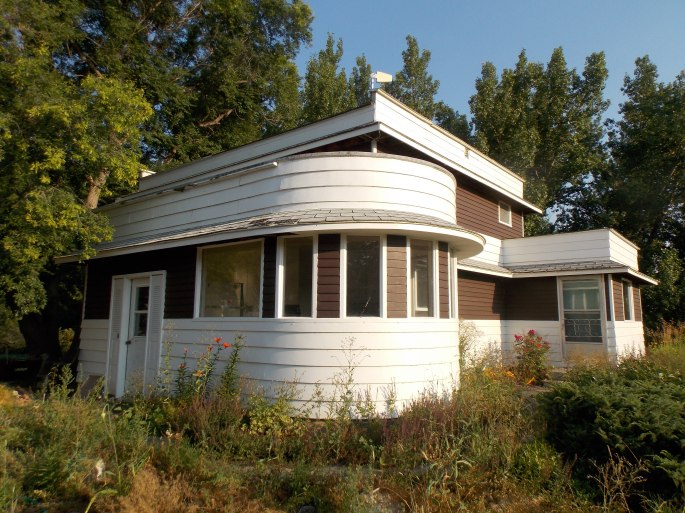
With the rounded kitchen looming like a prow, the house has the look of a ship: one of those Mississippi riverboats, or maybe Noah’s Ark. A neighbour told us that a pathologically lying visitor had tried to convince them that the fellow who built it had been a ship captain.

My sister Heather and I used to imagine our house was a ship and that our bicycles were lifeboats. Dad had poured a sidewalk from the front door on the east side of the house (a door never used) around the kitchen, past the main entrance on the south side, to the staircase on the west that led to the roof. This sidewalk, we imagined, was part of the ship. The major challenge of the game was to avoid touching the ground as we rode our bikes around the yard.

20407_10151556311498289_1796936502_n

If you put your foot to the ground to get your balance, you were considered drowned.

Thank You, Frank Lloyd Wright

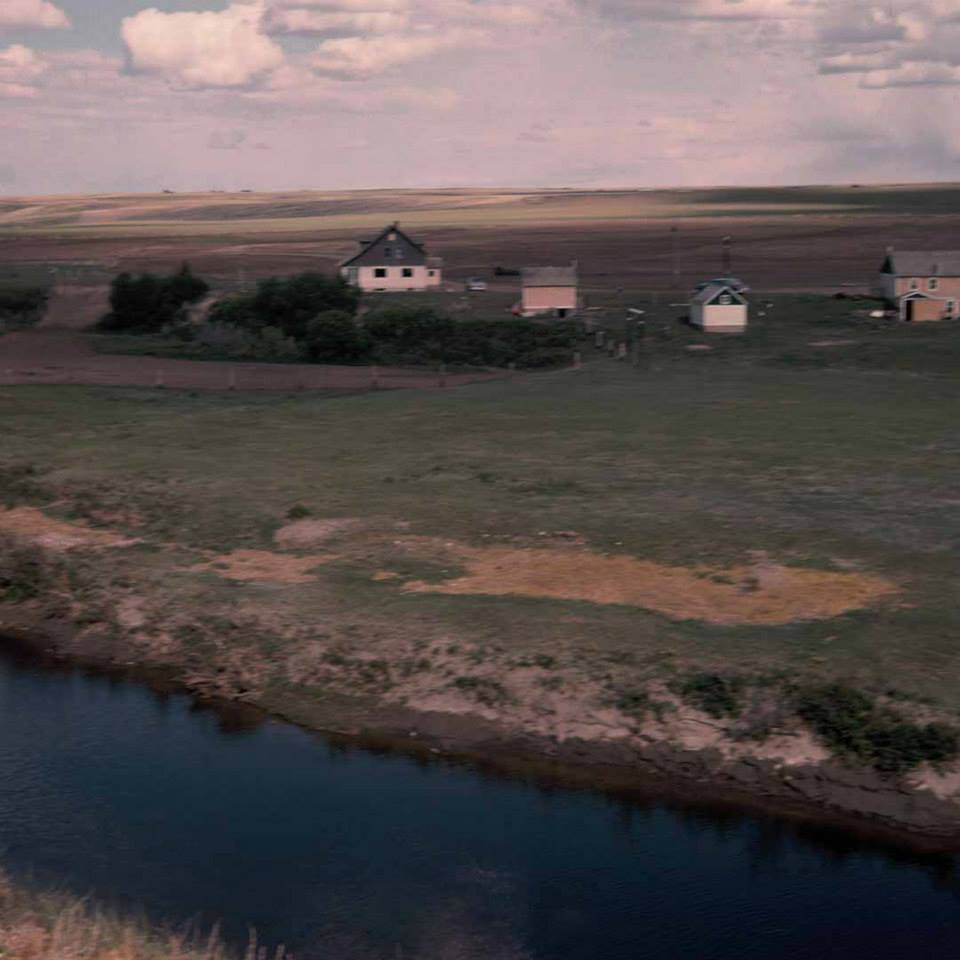
The house’s most remarkable features are the flat roof and curved kitchen. My grandfather had nothing to do with either. In the late 50s Nelson Gowan bought a farm right smack on the American border and moved himself and my grandmother down there in the exact middle of nowhere, leaving the farm to his two boys and the house to his youngest and most recently married son, Joe, who immediately began planning major renovations.

10647080_10153160557063289_4945586276444978878_n

My grandfather’s design had a traditional peaked roof, but my father had seen photographs of the buildings of Frank Lloyd Wright and was struck by the genius of Wright’s insight that a prairie home, given the lack of moisture in the Western climate and the wind that blew incessantly, sweeping any accumulation of snow away, had no need for a peaked roof. Those redundant peaks were nothing more than a waste of space and materials: an inheritance imported from the oppressively damp and moulding East. So Dad cut the peak right off the building and added a full second storey, making its lines horizontal like the surrounding prairie landscape.

imgres

I’m not sure if he got the idea for the kitchen from Wright. It wasn’t really a characteristic of the prairie style home, but you can certainly find curves in Wright’s buildings: The Guggenheim, for example. Dad went with his family to the World’s Fair in New York City in 1940, but The Guggenheim wasn’t completed until 1959 so that wouldn’t explain his inspiration. On the other hand, 1959 was about the time Dad was building the kitchen, and perhaps he saw photos of The Guggenheim in a magazine. Maybe not. Maybe it would be a bit grandiose for me to claim the house was influenced by The Guggenheim.

imgres-1

Still, it was an ambitious undertaking. Dad wanted the horizontal cedar siding to match the rest of the house, but in order to curve the siding around his turret of a kitchen he had to custom-make each piece like a smile that went flat when shaped to the curved surface. Stucco would have been much simpler, but Dad had a thing for cedar siding, either vertical or horizontal. He used it on all his buildings, including the wooden grain bins. Except the barn. And even the barn was painted to match the palette of the rest of the buildings on the farm: a strip of reddish brown about four feet, topped by a strip of white about four feet, the same pattern repeated on the second storey. The colours were chosen to match his herd of Hereford cattle.

10872737_867961616600823_2987135956752406468_o

The Dining Room

My father may not have literally been born in this house, but he was a baby here, and grew up in these walls with his four siblings through the Dirty Thirties and World War II. Our dining room was also the dining room when he was a child. We did not eat in the dining room every day, but he must have eaten thousands and thousands of meals in that room, almost all of them cooked by his mother and then by my mother.

He never called any other place home.

He married my mother, Laureen Gowan, in 1957, renovated the house that his father had built, planted thousands of trees, raised cattle, grew grain, stuffed birds, restored gramophones. Impossible to summarize a life in a list.

393262_10151432248778289_717553407_n

Dad died in the dining room, some of his gramophones around him. I can see the place where his bed was below the dining room window from my spot here at the kitchen table where I type these words. I was sitting here eating my supper when he died on Saturday evening, January 6th, 2007. My mother sat across the table from me. Neither of us had much to say. I got up after we’d finished and walked into the dining room to check on him, and he was gone, his glazed eyes open and his mouth frozen in a rigid contortion as if he were gasping for air.

I called my mother and she came in and we sat with him awhile, holding one another, quietly weeping, and then I called my brother Ray. Five minutes later he was there.

1467363_10152451921428289_462412112_n

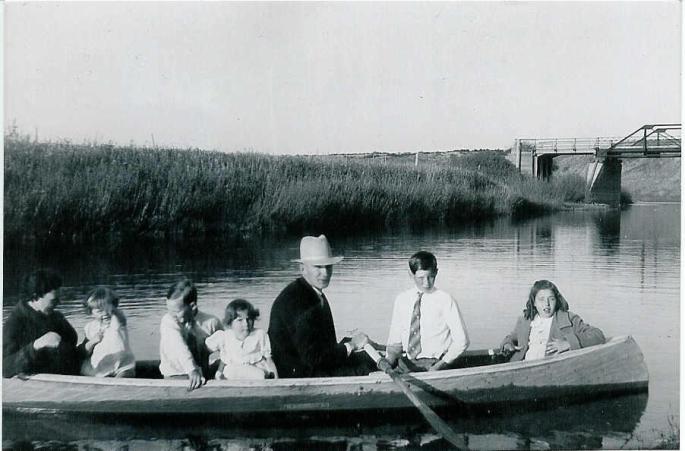
1929

My father was born in 1929, so this photo must have been taken in the late 30s. My father is the third from the left. His mother, Gladys, is at the front of the boat, on the extreme left, and my grandfather, Nelson Gowan, is at the oars. Dad’s youngest sister Carmel is to the left of him, waving to us, his sister Shirley to his immediate right, and his older sister Juanita at the back of the boat. It’s one of the only times I’ve ever seen his older brother Howard wearing a tie.

When my father was born on Christmas Eve 1929, my grandparents were not only facing the loss of their house, built just a couple of year’s before; the world had also just endured the stock market crash. I have no idea whether my grandfather had any investments aside from his land and cattle. He may have believed that people trading pieces of paper in New York and Chicago and London and Toronto and Winnipeg had little to do with his life, but he would discover that they did when the market for his grain and his cattle dried up completely in the coming years.
Dust_Bowl_-_Dallas,_South_Dakota_1936

Meanwhile his world dried up completely (though perhaps that could not be blamed on the people trading paper). The sky refused to rain, the fields all around turned to dust, and ninety percent of his many neighbours packed their things and went away.

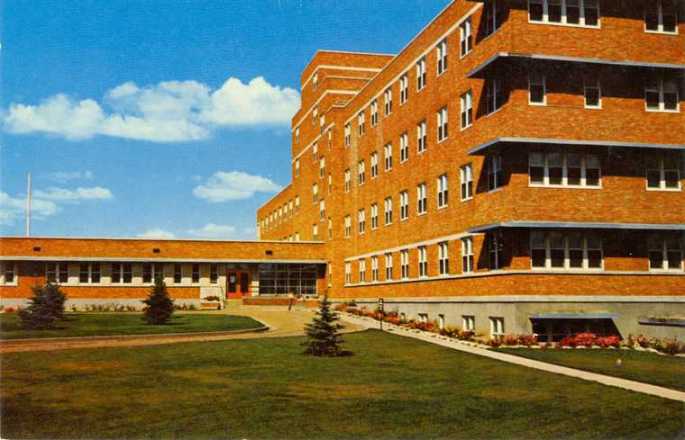
Swift Current Union Hospital

I spent the first few nights of my life at the Swift Current Union Hospital and then didn’t spend another night in any hospital through over four-and-a-half decades until 2007, when I shared my father’s room there for a few nights during the last month of his life.

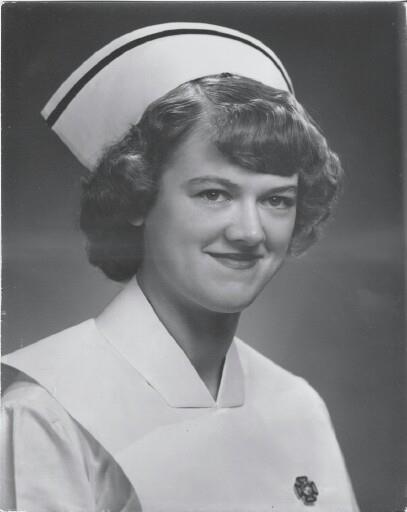
My father may have been born there too. I’m not sure. I know my grandfather met my grandmother when he was recovering from an accident (broke his leg while blasting something with dynamite) in a hospital in Swift Current. My grandmother was a nurse, my grandfather a homesteader. A pioneer.

My father was born on Christmas Eve in 1929. Considering my grandparents’ house had burned to the ground a couple of months previously, it is unlikely he was born at home. So he may well have been born in whatever hospital they had Swift Current at that time.

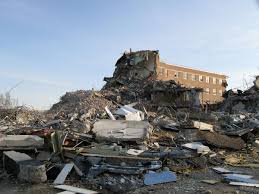
My mother was a nurse too and worked and lived at the Union Hospital when she first came to Swift Current in the 50s. The place runs like a spine through my life. I tried to find the date when the hospital was built, but couldn’t. It was demolished a few years ago, not long after I spent a couple of nights there in my father’s room.

imgres.jpg

I slept in a cot by the window. The nurses would come by and point a tiny flashlight into the room to check if all was well. In the middle of the night he woke and called me.

“Lee! Lee! Run out to the shop and get me a piece of tin and some tin-snips.”

“Why, Dad?”

“I need a piece of tin to cover the hole.”

“What hole, Dad?”

“The hole in the roof. There’s a hole in the roof and the light’s getting in.”

This is my father’s house.

It’s impossible not to feel my father here at the same time as it’s impossible not to feel his absence here. Everything around me was planned and built by him.

I’m at the kitchen table, in the dead-end of the nook where I sat for most meals growing up. It’s breakfast time, but there’s no food in the fridge, none of my mother’s canning in the cupboards in the basement, no vegetables in the root cellar.

A thin layer of plaster dust partly covers the wood-grain Formica that covers the table. Someone, probably my brother Ray, started mudding a spot of water damage on the ceiling almost directly over my head; got so far as sanding, but it looks as though it needs more mud, or perhaps the water that damaged it in the first place is still getting in, and the job was abandoned until the roof is fixed.

I listen for my losses and my ears ring.